The velvet rope, "not subject to SEC review"
The SEC has set the rules for a new kind of venue where the actual share, with its vote and its dividend, will trade on a blockchain. The chain has to belong to everyone. The enclosure does not: whoever holds the list ropes it off.
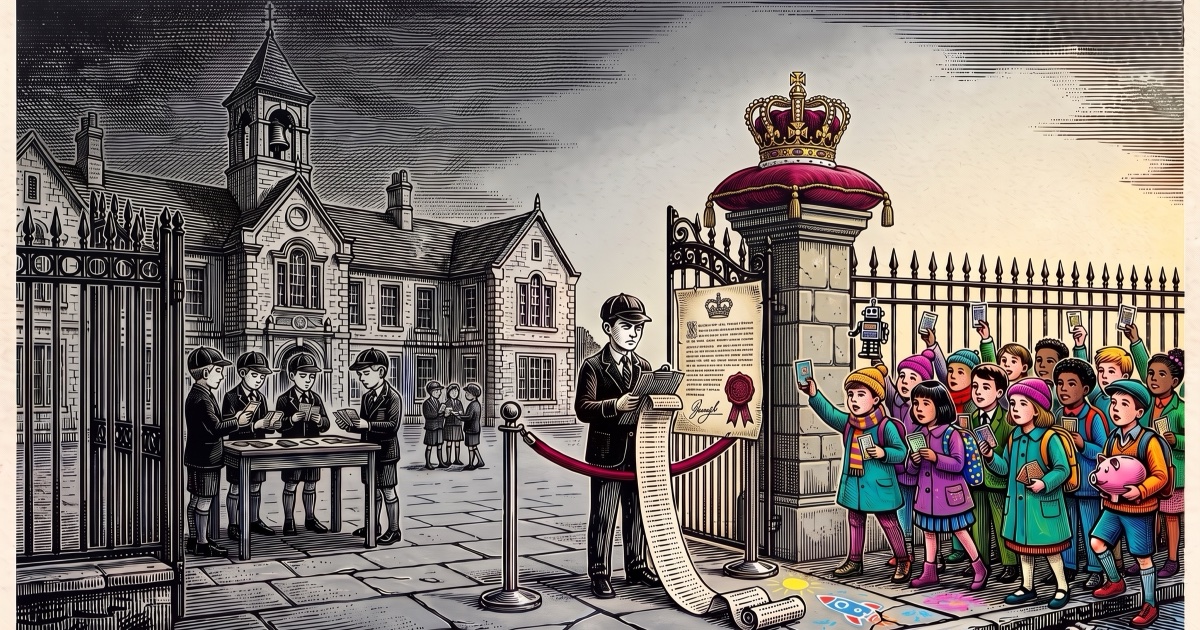
In medieval Castile, nobody could just set up a fair. Fairs were a royal prerogative: the king granted one by charter, fixed its days and took responsibility for the safety of anyone who came. Over time, many were exempted from the portazgo, the toll for passing through. The town assigned stalls and plots and sometimes marked off the fairground with nothing fancier than a rope. Nobody called it a free market. They called it a privilege. Keep that in mind.
Today the SEC published sixty pages and 118 footnotes that read just like that (Release No. 34-106402). We read them so you don't have to, because we got kicked out of the golf course.
The good part, and it is very good
The first thing the order does is say what a tokenized stock is. And here, credit given where it's due, it gets it right.
A "Tokenized NMS Stock" is a listed share tokenized by the company itself or by a third party unaffiliated with it. A venue that wants to trade it has to verify that the token provides "the same rights and privileges as does traditional NMS stock of an equivalent class" (p. 23). Among other things: the same interest in the company, the same dividends, the same vote and the same share of what is left if the company is liquidated. If a third party does the tokenizing, that third party also has to pass the proxy materials on to holders, at no cost to them or to the issuer.
It also says what stays out: a third party issuing "a crypto asset representing its own security that provides synthetic exposure to an underlying security" (p. 2). In plain English: a security of the third party's own that mimics the share without being it. The SEC names categories, not products, so matching them to products is our reading. The Jersey certificate and the note sold with a prospectus are not the share. They are an IOU on the share, and an IOU is not the share. SEC staff had already drawn that line on January 28; now the Commission turns it into a condition.
There is money riding on that line. RWA.xyz, read on September 17, shows $2.82 billion in tokenized stocks. Nearly eight of every ten of those dollars sit in products from four third-party issuers: Ondo, bStocks, xStocks and Robinhood. The order names none of them, and being a third party keeps no one out: what counts is whether the token carries the same rights. Laura Shin, in her thread on X, puts Robinhood's debt tokens, the Ondo and xStocks products and Hyperliquid's stock perpetuals outside the definition. She says nothing about bStocks, and neither will we until we have read its terms. What does the SEC plan to do about all that? It hasn't said. On what stays out, an SEC spokesperson told Unchained: "They can remain out in the wilds." Outside this fair, then.
3/ What's left out: synthetics. That covers Robinhood's debt-based stock tokens, Ondo and xStocks notes, and stock perps on Hyperliquid, which is most of the onchain equity action right now.
— Laura Shin (@laurashin) September 17, 2026
Note, too, the word the order does not use: "regulated." Paperwork does matter: the offering has to be registered or exempt (p. 22). But a prospectus doesn't turn a note into a share, any more than a tuxedo gets a horse into the opera. What draws the line is what actually reaches the holder, in their pocket and at the shareholder meeting.
So far, applause. Now for the rest.
The velvet rope
The thing is called a TSV, short for Tokenized Securities Venue. It runs the pools, the shared pots of tokens people buy and sell against, and it decides who gets in. It has to be a "U.S. person" (p. 19), which, as the order uses the term, includes any company organized in the United States. Only "permissioned TSV Participants" may trade on it (p. 10). They can be verified offchain or onchain, for example. The list can live in the pool or in the token itself, and if it lives in the token, the token can only move to approved wallets. Retail investors can take part (p. 16). If they're let in.
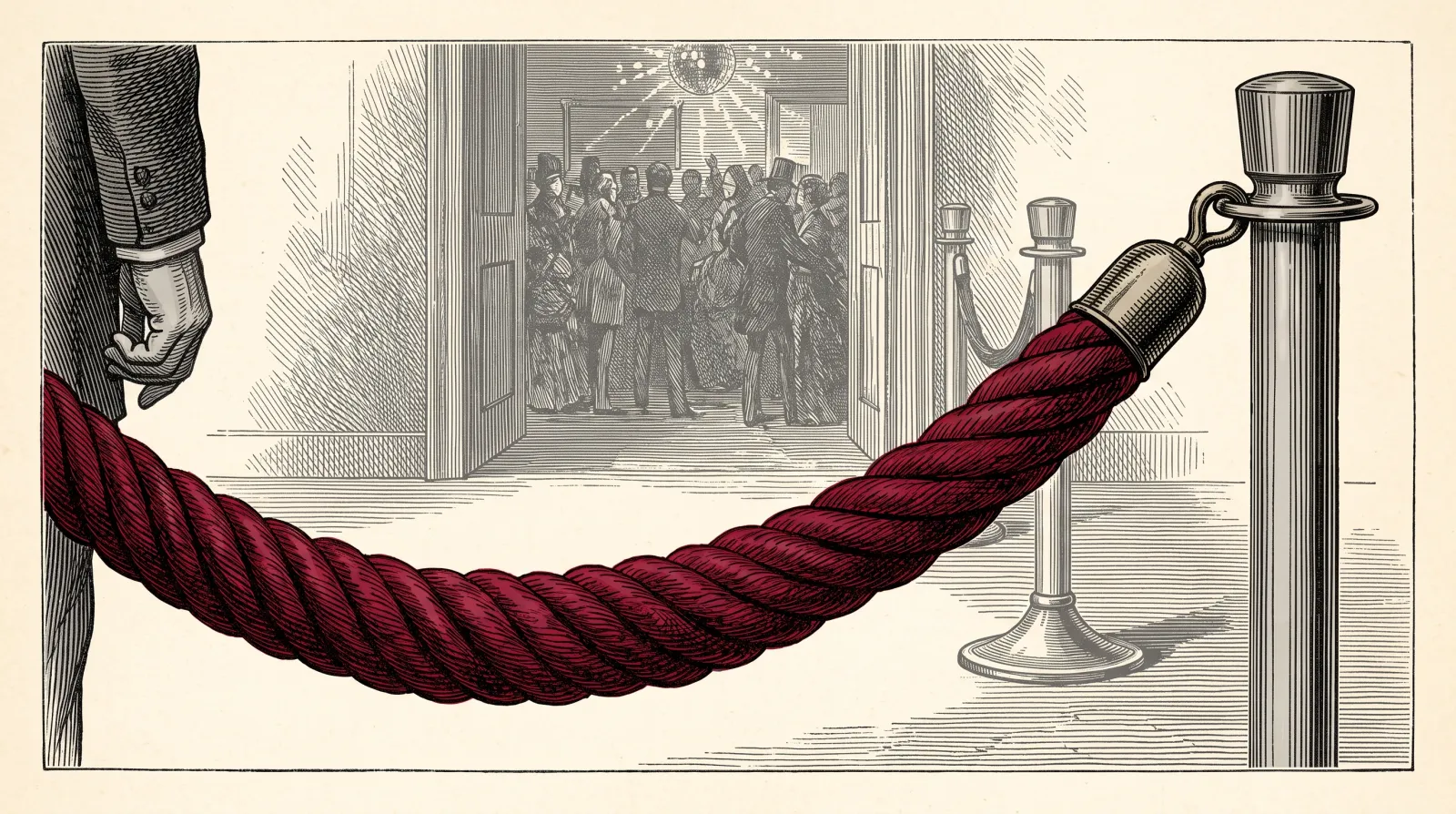
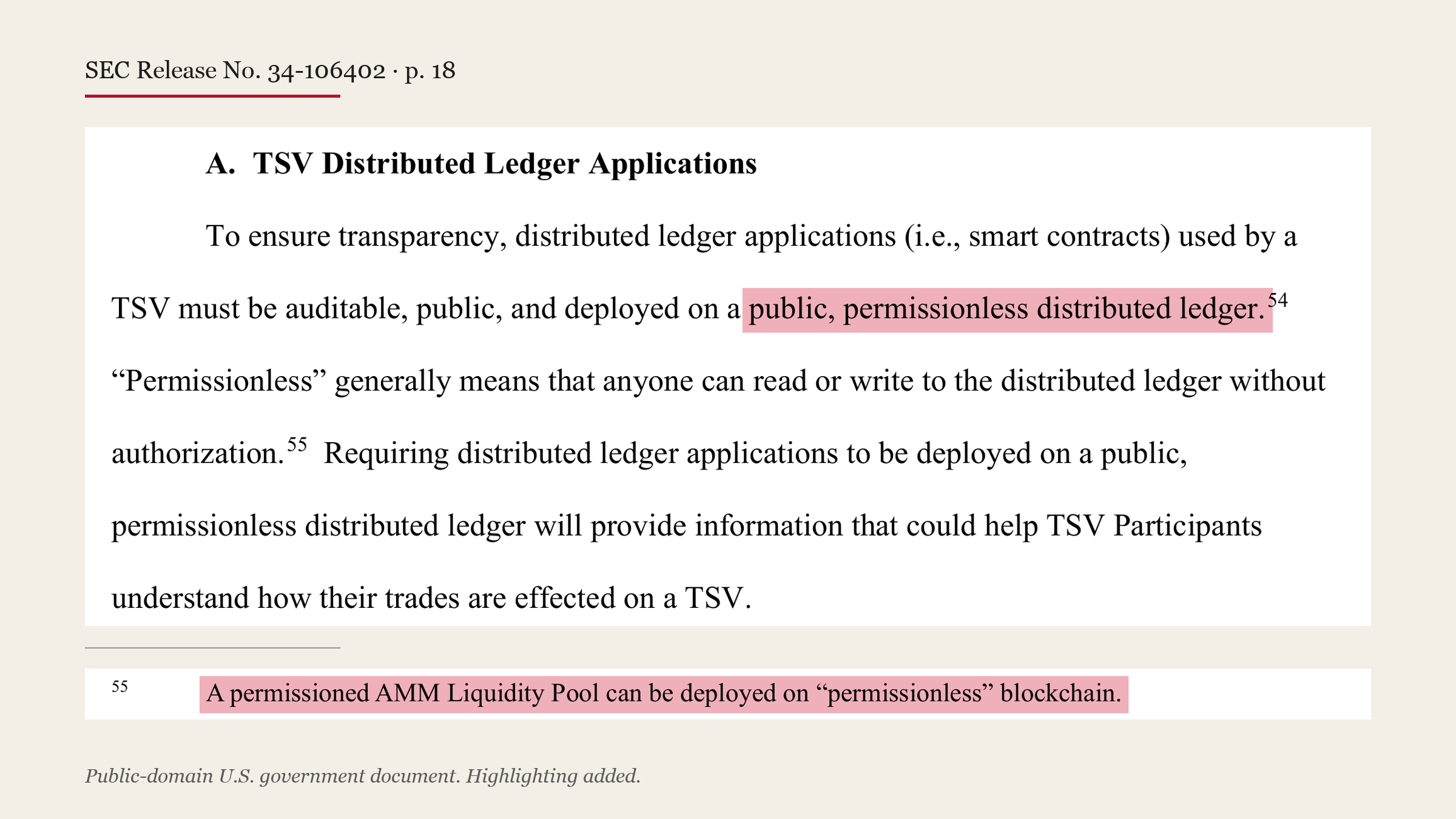
The best line in the document comes in two beats. First, the TSV's smart contracts have to be deployed on a "public, permissionless" ledger, one where anyone can read or write without authorization (p. 18). Then footnote 55 delivers the punchline: "A permissioned AMM Liquidity Pool can be deployed on 'permissionless' blockchain." The chain belongs to everyone, by rule. The pool belongs to whoever holds the list. It's Studio 54: the sidewalk is public, the velvet rope is not.
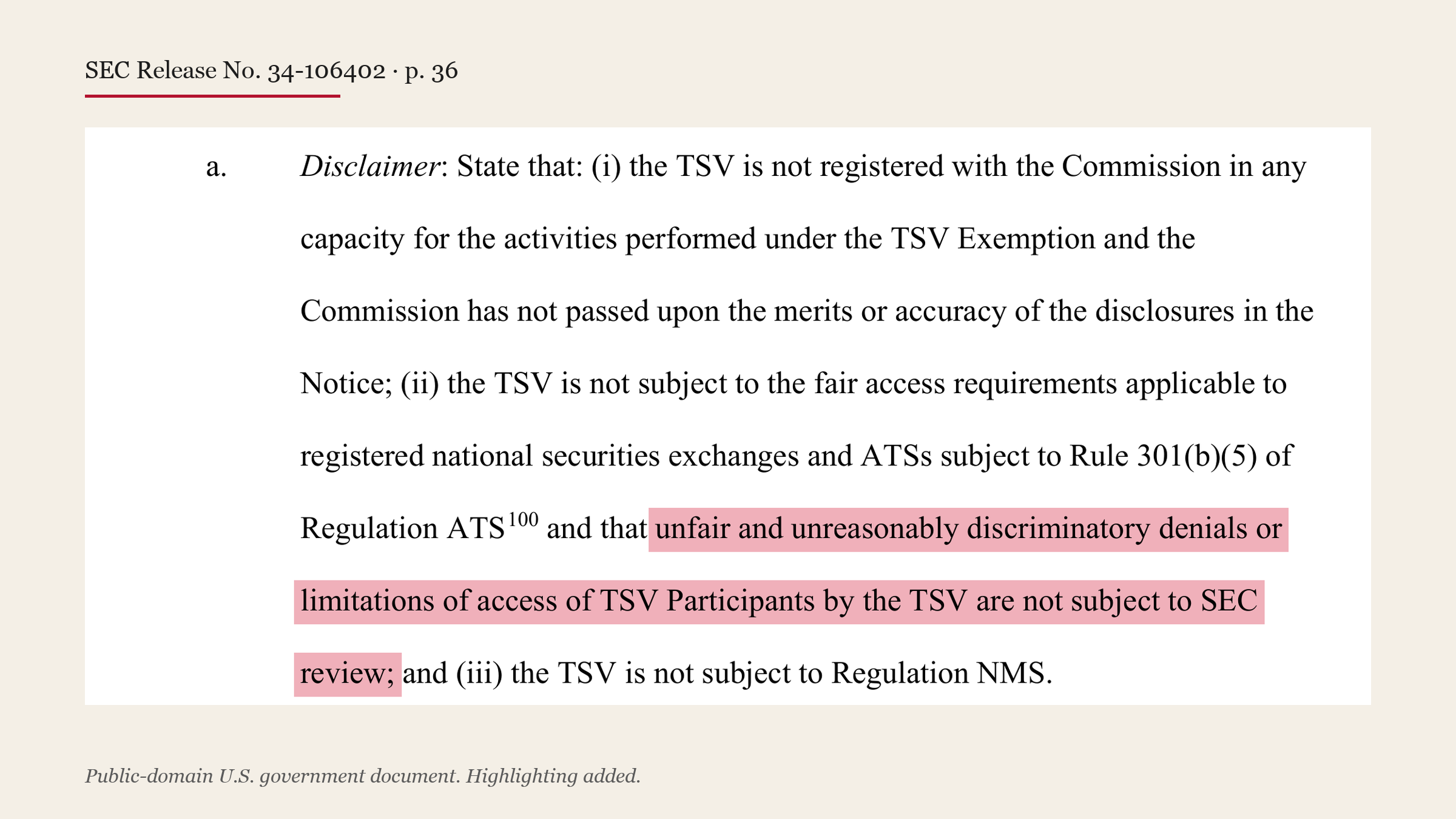
So who watches the first doorman? Every TSV has to post a Notice on its website. In it, the TSV must state two things: that the fair-access rules for exchanges do not apply to it, and that its unfair and unreasonably discriminatory denials or limitations of access "are not subject to SEC review" (p. 36). The operator holds the rope. If it keeps someone out unfairly, the SEC does not review it, and says so in writing.
The second doorman is the company. If a third party tokenizes the stock, the TSV has to notify the issuer in writing and wait 30 calendar days from the day the issuer receives the notice. If the issuer objects within that window, that stock stays out (pp. 21-22). The order is silent on silence, but if the issuer never answers, nothing keeps the stock out. In July, the trade association for transfer agents (the firms that keep shareholder registers) had asked for more: issuer authorization as a precondition. On September 3, Adam Aron, AMC's CEO, wrote that he found it "vile" that Robinhood was issuing tokens tied to AMC's stock. As of today, he has a button. A button that doesn't reach Robinhood. Its tokens are debt of the Jersey company that issues them and are sold only to non-U.S. persons. On Laura Shin's reading, they would not even get into the fair.
The rest of the house rules, quickly.
What may go in
- PairsWhat the stock can trade against: another tokenized stock, a tokenized money market fund or any crypto asset that is not a security. A payment stablecoin is only the example the order gives (pp. 7-8).
- CapsTier 1 (the S&P 500, the Russell 1000 and some exchange-traded products) gets 75 symbols at most, each capped at 0.25% of the prior month's average daily volume. Everything else gets 250 symbols and 2.5%. The first breach is on the house. Every breach after that means three months without recess for that stock (pp. 24-27).
- No creditThe TSV cannot borrow, cannot pledge what is inside and cannot lend anyone money to buy (pp. 32-33).
When it opens
- HoursEach TSV sets its own hours and has to say whether that means 24/7 (p. 42).
- HaltsIf the exchange where the stock is listed halts it, the TSV halts it too (p. 30).
What nobody owes you
- DealersA firm that supplies liquidity with its own capital and also acts like a dealer, quoting prices to customers, for instance, is carved out of the definition of dealer, subject to conditions (pp. 4 and 52-57).
- Reg NMSSince a TSV is not an exchange, Regulation NMS, the rulebook of the national stock market, does not apply to it, and it has to say so in its Notice (pp. 14 and 36).
- PriceThe order never mentions best execution, the duty to get the customer the best price. RWA Llama draws the conclusion: on price, the buyer is on their own. One caveat from us: that holds for anyone who walks in with their own wallet, because the order leaves the obligations of brokers trading there untouched (p. 16).
- BackingA venue must verify that the token carries the same rights and privileges as the share (p. 23), and its Notice must describe the steps it took, "e.g., audits, certifications, attestations" (p. 39). Describe, not obtain: the order requires no independent audit, names no custodian and asks for no proof that the shares behind a third party's tokens exist. The check is the venue's own, and what a reader gets is the venue's account of it (p. 48). Access is disclosed rather than reviewed on page 36; so is the backing, three pages later.
- DeFiSnapping one protocol into another was the whole point of putting a share on a blockchain. If the list lives in the token, anyone liquidating on Aave, selling the collateral when a loan's backing runs short, would have to be on the list. So would any vault that takes the share as collateral. The order doesn't ban it: it asks the TSV to explain whether its contracts can connect with anyone else's (p. 40).
🎯 One protection did not come along. The venue is not an exchange and its liquidity providers are not dealers, so a best-execution duty has nothing to attach to. Anti-fraud still applies. But no best execution, no order protection. On price, the buyer is on their own.
— RWA Llama (@RwaLlama) September 17, 2026
One protection does not go anywhere. The exemption is from the definition of an exchange, not from the anti-fraud rules: a TSV stays subject to section 10(b) and Rule 10b-5 (p. 15), and so does a Covered Firm supplying the pool (p. 55). It is a floor, and it is not a price. Fraud is still fraud. A bad fill is still your own.
In July 2025, the report of the President's Working Group (PWG) had proposed looking at changes to Regulation NMS to make room for oracles, aggregators and "other DeFi constructs" in securities trading. What arrived is a pool with a guest list and no credit. Commissioner Hester Peirce says as much: "This order is not about decentralized finance." In her view, nobody needs an exemption to use permissionless contracts peer to peer. Maybe so. What comes with a date, conditions and five years on the clock is the fair with the rope.
Twenty months, with dates
The order sets out its own backstory on pages 4 to 6, footnotes and all, which is how we like to be told things. Add a couple of other documents and you get this.
- January 21, 2025Mark Uyeda, then Acting Chairman of the SEC, sets up the Crypto Task Force (footnote 11).
- January 23, 2025Donald Trump signs Executive Order 14178 on digital assets (footnote 16). It calls, incidentally, for protecting access to "open public blockchain networks."
- April 21, 2025Paul Atkins, nominated by Trump and confirmed by the Senate, is sworn in as SEC Chairman (footnote 11).
- July 30, 2025The President's Working Group publishes its report (footnote 17). It asks the SEC for a conditional "innovation exemption."
- July 31, 2025Atkins launches Project Crypto to develop proposals that, in his words, "implement the PWG's recommendations." He calls it "the SEC's north star in aiding President Trump in his historic efforts to make America the 'crypto capital of the world'" (speech cited in footnote 18).
- September 15, 2026The CLARITY Act falls short of the 60 votes it needs in the Senate to open debate.
- September 17, 2026This order. Early in his statement, Atkins notes that Congress failed to move that bill.
All of it on the record. In its own words, the order is informed, in part, by what the public has told the Commission (p. 6). Nor did it get here in a straight line. In August, according to a source quoted by CoinDesk, the White House itself worried the exemption could "kick a hornet's nest" while CLARITY was being negotiated, and Wall Street was pushing back too. No need to imagine anything: every date above has a source.
The exemption expires on September 17, 2031, unless the SEC changes the term, which the order allows it to do (p. 57). Atkins presents it as a way to trade "in a permissioned environment today while the Commission considers the need for additional action to facilitate onchain trading." Five years is a very long "today," even for a regulator.
Who holds the velvet rope?
It's the question half the industry is going to ask, so we checked it against the order. The profile comes out blurry: any US company (p. 19), verified wallets and a venue that does not finance anyone (pp. 32-33). The order does not even require the operator to have its own stablecoin (p. 8). That profile could fit Coinbase, Circle, Paxos or Anchorage, which already have OCC charters or charter approvals at different stages, and also World Liberty Financial. As of September 17, none of them has announced a TSV. The order has no name on it. The rope will: the name of whoever holds it, which we will learn from the Notice.

What is next
As of today the order draws this line: whoever does the tokenizing, "the same rights and privileges."
When a TSV posts its Notice, we will read the whole thing and report what it says about the rope. Who can get in and why. Who owns it and who governs it. Whether the operator or its affiliates tokenize or trade inside. Whether it monitors the market or says it does not. The Notice has to go up at least 30 days before the venue starts operating, so none can open before October 17. Same yardstick, whoever the operator is. No fair privileges here.
Comments are open (File No. 4-927), and the order sets no deadline. There are ten questions. Question 4 asks whether TSVs could trade other securities and what they could pair them with. Question 6, whether the caps are appropriate. None asks outright whether the rope is needed. That fits under questions 1 and 5, which ask whether anything should change.
The share that trades there will be the real thing, not an IOU. Depending on how the operator sets things up, it will also need permission just to sit in its owner's wallet. In medieval Castile that had a name too: it was called a fair. The road, which belonged to everyone, was something else.
Obituary of the day. Today we say goodbye to "tokenization is permissionless," a phrase born in a thousand pitch decks and deceased on September 17, 2026, on page 36 of an SEC order. There, every TSV is required to warn that the SEC does not review its unfair and unreasonably discriminatory denials of access. It is survived by the chain, permissionless by rule (p. 18). In lieu of flowers, please send a comment to File No. 4-927.
Trivia. On August 6, 1116, Alfonso I the Battler granted the town of Belorado a charter with a Monday market and a yearly fair at Michaelmas, the feast of St. Michael, one of the oldest documented fairs in Castile. The original is lost: we know it from copies. Nine hundred and ten years later, the privilege is still being cited. The fair, not so much.
Not advice. The facts carry a source and a page; the rest is our reading.
Sources
Pages and footnotes refer to the SEC's PDF. The Federal Register version has not been published yet and will be paginated differently.
The order and the SEC
- SEC, Release No. 34-106402, File No. 4-927, September 17, 2026, "Order Granting Temporary Conditional Exemptive Relief [...] for Certain Distributed Ledger Trading Venues for Tokenized NMS Stocks and [...] for Certain Liquidity Providers for Tokenized NMS Stocks, and Request for Comment" (definition and synthetic exclusion, p. 2; Covered Firm, p. 4; background, pp. 4-6, footnotes 11, 16, 17 and 18; pairs, pp. 7-8; permissioned participants, p. 10; Regulation NMS, pp. 11 and 14; anti-fraud and Rule 10b-5, p. 15; participants and brokers, p. 16; "public, permissionless" and footnote 55, p. 18; U.S. person, p. 19 and footnote 56; Notice, pp. 19-21; issuer notice, pp. 21-22; registered or exempt offering, p. 22; same rights, p. 23; caps, pp. 24-27; halts, p. 30; no financing, pp. 32-33; Notice contents, pp. 36-46, including the access warning, p. 36, the tokenization steps, p. 39, and interoperability, p. 40; hours, p. 42; why the Notice asks for the tokenization steps, p. 48; dealer exemption, pp. 52-57, and the Covered Firm's anti-fraud duty, p. 55; term, p. 57; questions, pp. 57-59)
- SEC, fact sheet for the order
- SEC staff, "Statement on Tokenized Securities," January 28, 2026 (cited in footnotes 2 to 4 of the order; treats a "linked security" as synthetic exposure even when backed)
- SEC, press release 2026-90, September 17, 2026
- Paul S. Atkins, "Statement on the Innovation Exemption: A Bridge Toward Durable Rulemaking," September 17, 2026
- Hester M. Peirce, "Slumber Number: Innovation Exemption Statement," September 17, 2026
- SEC, press release 2025-68 (Atkins sworn in; nominated January 20 and confirmed April 9, 2025)
- Paul S. Atkins, "American Leadership in the Digital Finance Revolution," July 31, 2025
- Securities Transfer Association (Peter Duggan), letter to the Crypto Task Force, July 1, 2026
White House, Congress and regulators
- Executive Order 14178, "Strengthening American Leadership in Digital Financial Technology," January 23, 2025, 90 FR 8647
- President's Working Group on Digital Asset Markets, report of July 30, 2025 ("innovation exemption," p. 51; "other DeFi constructs," p. 52)
- OCC, news release 2025-125, December 12, 2025 (conditional approvals for Circle, Ripple, BitGo, Fidelity Digital Assets and Paxos)
- OCC, news release 2021-6, January 13, 2021 (national charter for Anchorage Digital Bank)
Companies
- The Block, July 10, 2026 (final OCC approval for Circle's trust bank)
- Robinhood, newsroom post, July 1, 2026 (Stock Tokens not available in the US or to US persons)
- CoinDesk, April 2, 2026 (Coinbase's conditional trust charter)
- RWA.xyz, tokenized stocks dashboard, read on September 17, 2026 ($2.82B distributed value; Ondo $823.2M, bStocks $710.7M, xStocks $530.1M, Robinhood $147.5M)
Press and analysis
- Unchained (Laura Shin), "SEC Grants Innovation Exemption for Trading Stock Tokens Onchain, but Not Synthetics," September 17, 2026 (the spokesperson and "out in the wilds")
- Laura Shin (@laurashin), thread on X, September 17, 2026 (which products stay out)
- RWA Llama (@RwaLlama), thread on X, September 17, 2026 (best execution)
- Unchained, "AMC CEO calls Robinhood's tokenized shares vile [...]," September 4, 2026
- CoinDesk, August 13, 2026 (the exemption delayed again)
- CoinDesk, September 15, 2026 (the CLARITY Act vote)
History
- Miguel Ángel Ladero Quesada, Las ferias de Castilla. Siglos XII a XV, Madrid, 1994 (the royal fair prerogative, p. 104; organization by the town and the rope, p. 105; toll exemptions under Alfonso X, p. 81)
- Inocencio Cadiñanos Bardeci, on the 1116 charter of Belorado, Cuadernos de Historia del Derecho 21 (2014), pp. 31-52
The chain is public. The pool has a list.