Memecoins are doing the dirty work for tokenized stocks.
A 1923 corner, a Sunday at 23:36 UTC and a dried-mushroom company. In one week two memecoins on Robinhood Chain measured what two years of institutional adoption never bothered to: what a shut mint counter costs on a Sunday, up to 112%, and what a bare ticker on a chain does to a Nasdaq micro-cap, 350% in a session. Nobody hacked anything. Twice.
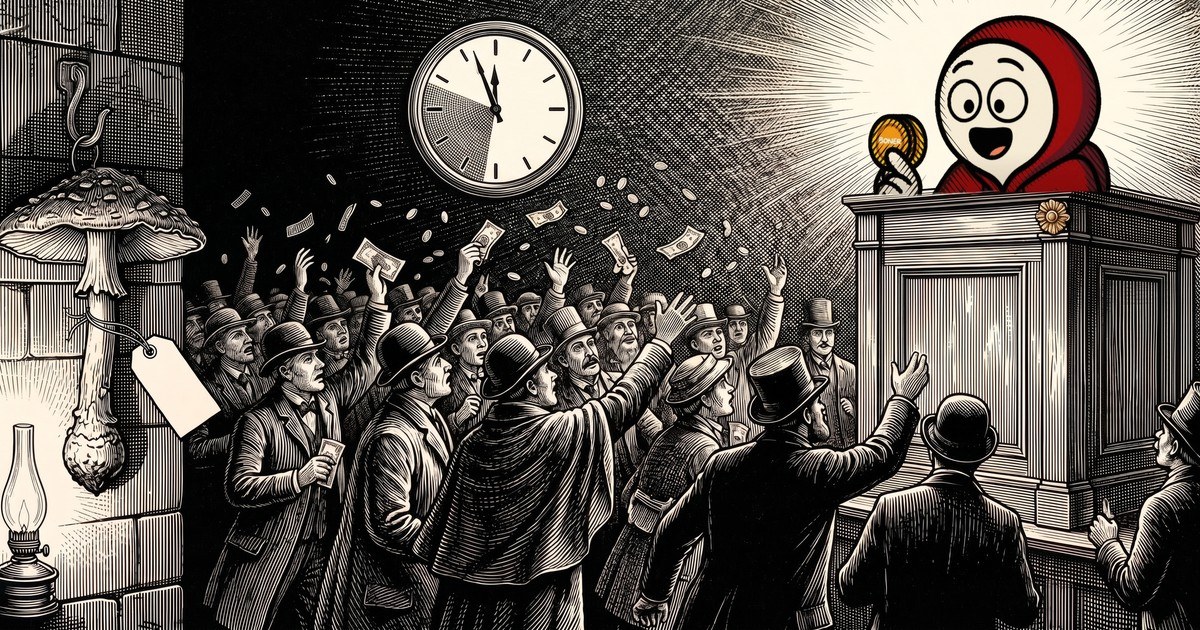
In 1923 Clarence Saunders, founder of Piggly Wiggly (the supermarkets, not the chicken), cornered his own stock and won. For a day. A corner, for the record: you buy so many shares that the people who are short cannot find any to close, and they pay whatever you say. The New York Stock Exchange suspended trading, gave the shorts a few extra days to deliver and pulled the stock off the floor. Saunders ended up broke. The off switch is more than a hundred years old, and it is always the same hand on it.
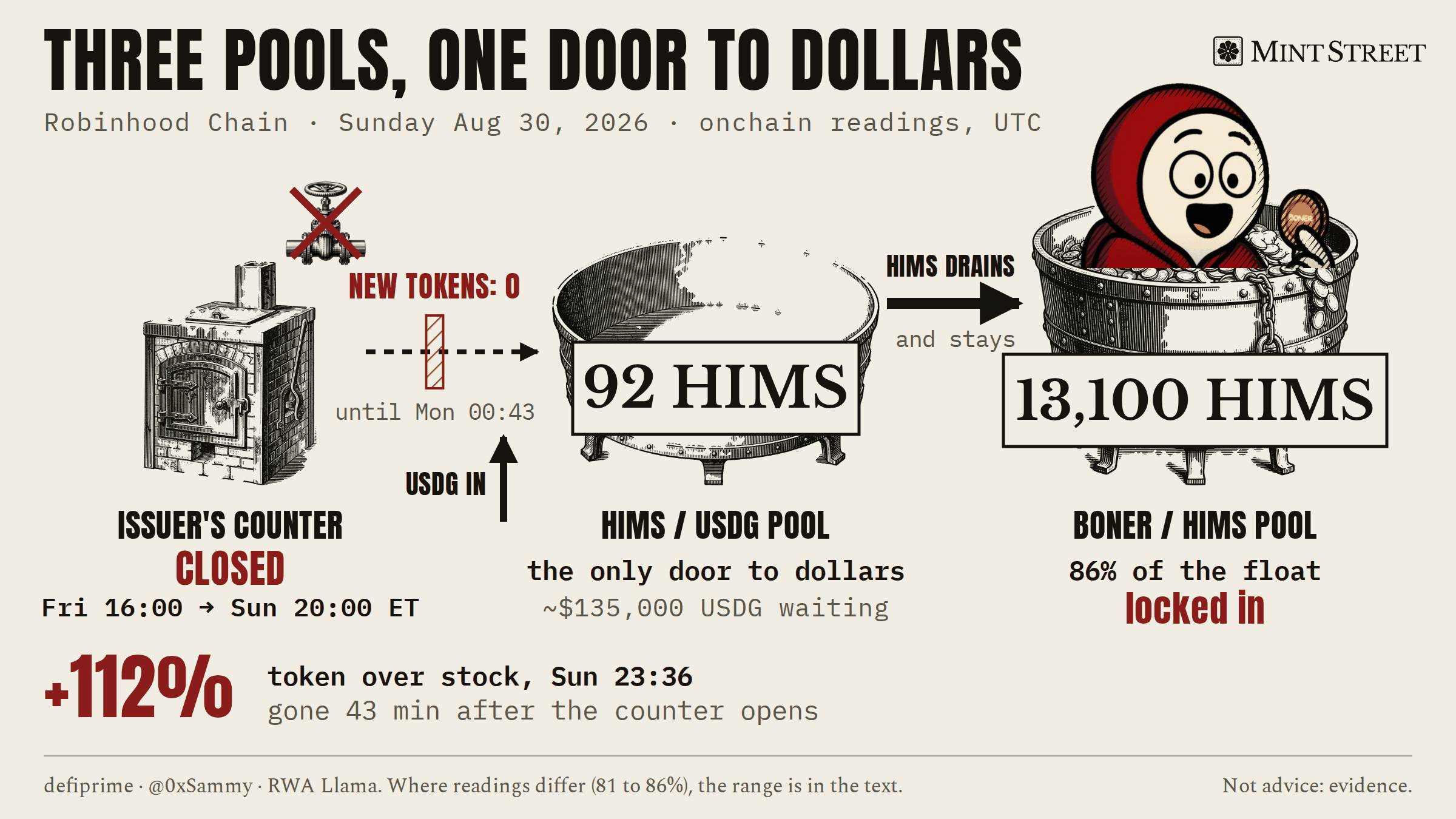
About a hundred years later. Sunday, August 30, 23:36 UTC. The Hims & Hers token trades at $61 on Robinhood Chain. The stock closed Friday at 28.84. In 24 minutes, someone, somewhere on the planet, will be able to mint a single new token. And in those 24 minutes there are people buying.
Wednesday, September 2, Nasdaq open. Farmmi, a Chinese dried-mushroom company with fifteen employees, a few million in market cap and a Nasdaq notice for trading under a dollar, goes from 0.12 to 0.50. Seven hundred and twenty million shares traded, against an average of five. No announcement. There was nothing to announce. We are talking about mushrooms.
Nobody hacked anything. Twice. No bug, no exploit, no post mortem. It is the degens doing the dirty work for tokenized stocks.
Two memes
Let us see what on earth is going on. One is called BONER, and I am not going to explain the name. The other is called JINQIAN, "money mushroom" in Chinese, and I am not going to explain that one either. The first did in three days what two years of institutional adoption had not managed with any tokenized stock. The second did in one afternoon what no token had ever done: move the actual stock.
Sunday: the counter
A memecoin always launches against a pair. Against ETH, against SOL, against USDC. That is how it is done. On Robinhood Chain the degens changed the pair: instead of a "respectable" crypto, the token of a stock. They set up the raffle inside the pharmacy. BONER against HIMS. SAYLORMOON against MSTR. CINEMA against AMC. Vlad Tenev, Robinhood's CEO, had tweeted in July that they were building the chain for RWA but that it worked great for memes too. They took him at his word.
While we're building robinhood chain to be the best chain for RWA … it works great for memes too
— Vlad Tenev (@vladtenev) July 8, 2026
To buy the meme you have to pay in tokenized HIMS. Every dollar that goes into BONER is a buy order for HIMS, and that HIMS stays locked in the meme's pool, where it no longer answers to the stock but to the meme.
The numbers. There were 15,227 HIMS tokens on the whole chain. Depending on who you ask, more than 85% of them were inside the BONER pool. The only pool connecting HIMS to dollars held 92 tokens, which at $28 is about $2,600. The one open door of a $440,000 market had $2,600 behind it. The premium went from 3% to 112%.
At 00:00 the session reopens. Forty-three minutes later, normal tokens start getting minted and the premium disappears. Like a cuckoo clock.
A 112% premium is not what a bad instrument looks like. It is what a shut door looks like. A registered, whitelisted share sold by transfer agents instead will never trade above the share, in the way a painting in a bank vault never trades at all.
Thread: an onchain reading of the BONER/HIMS pool, 12,284 of the 15,227 HIMS tokens locked inside it.
— 0xSammy (@0xSammy) August 31, 2026
And why was nobody minting before? Because of the document. The Stock Tokens are issued by Robinhood out of Jersey and they are tokenized debt: backed one to one at a US custodian, no rights over the company, not registered in the United States. Only an authorized participant with KYB can create them. It is called BBVI, there is one of it, and on Sunday it is not at work: it only mints when it can buy shares, and on a Sunday afternoon it cannot. The counter was shut.
Who wins
Follow the dollar. Whoever mints the tokens on Monday morning buys shares at 28.84, sells tokens until the token is back at 28.84 and pockets every dollar of the premium. The launchpad wins. The meme's LPs win. The participant wins. Robinhood wins, with five times the float in custody after three days.
The one who loses is whoever bought HIMS at $61 on a Sunday afternoon.
Not one real share changed hands above 28.84. No short felt a thing. The corner was on the warehouse receipt, not on the goods.
Wednesday: no counter
All of that went through the counter. So let us remove it. Remove the Jersey issuer, the participant and the custodian. The only thing we leave is the ticker.
That is the FAMI token on Robinhood Chain, the one JINQIAN launched against. Robinhood did not issue it. It redeems for nothing. It is four letters that happen to match a company listed on Nasdaq, and that is all. With that and a meme called money mushroom, somebody put together a pair that reached $60 million. The mushroom company was worth six. The meme was worth ten mushroom companies and could not be exchanged for any of them.
And the stock went up anyway. 350% intraday, 720 million shares, close at 0.15. No arbitrage, because there was nothing to arbitrage. The stock went up because people saw the chain and bought at their broker.
This is wild. Farmmi, Inc. (FAMI: NASDAQ) is mooning from onchain trading through the 'JINQIAN' / Money Mushroom meme pair
— 0xSammy (@0xSammy) September 2, 2026
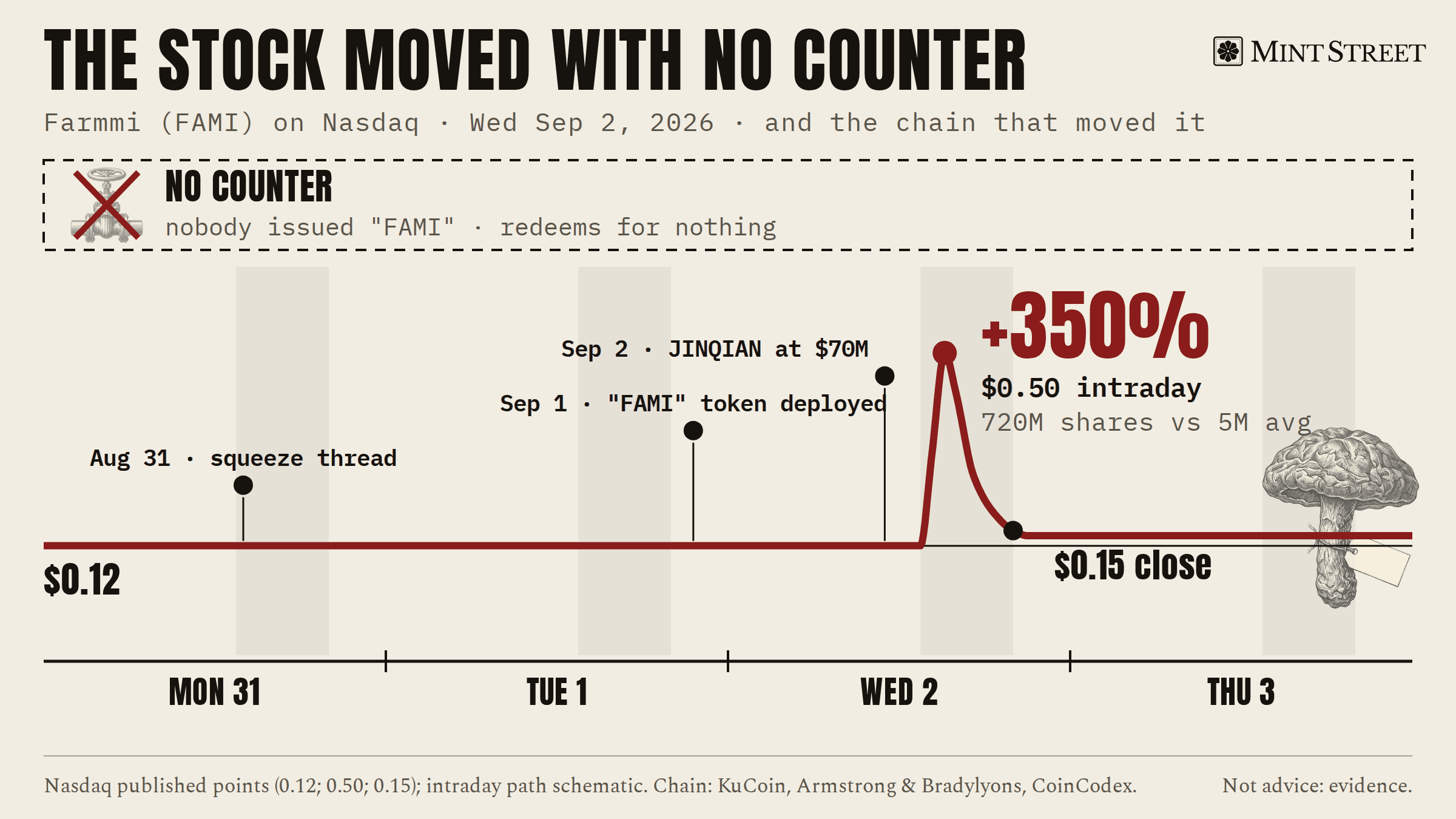
In other words: an unsupervised token market moved a security registered on a national exchange with attention alone. The synthetic does not need backing to move the underlying. It needs an audience.
The incumbents have one word for everything on this page: synthetic. It is meant as a dismissal. On Wednesday the dismissal put 720 million shares through Nasdaq.
What is going on
Memecoins are the auditor nobody wanted to pay.
Two years of institutional adoption, in quotes, had not put the mint counter of a single tokenized stock to work. BONER put it to work 294 times in one morning. And on the way it measured what keeping it shut on a Sunday costs: up to 112%.
Four days later, JINQIAN audited the other door. It found that a six-million-dollar stock on a delisting notice moves 350% if you hold up a mirror with its name on it, on a chain with a pretty name.
The question is what happens when we change the order of magnitude of the companies. When the audience is bigger. And more degen still.
Obituary of the week
Today we say goodbye to two much-repeated phrases. To the "24/7" of tokenized stocks, born in a 2024 deck and deceased on Sunday, August 30, at 23:36 UTC, surrounded by its family and a 112% premium, at its home on Robinhood Chain. And to "the token does not affect the stock", born at conferences and deceased on Wednesday, September 2, on Nasdaq, of 720 million shares, without a single token being redeemable for any of them.
They are survived by a counter with opening hours, an anonymous balance sheet and Nasdaq's list of companies on notice for trading under a dollar, which is long. In lieu of flowers, the family asks that somebody publish, out of charity, who holds the weekend. And that a good samaritan explain to Nasdaq what a launchpad is.
Not advice: evidence.
Sunday was a reading of one gate, Exit, on one version: a counter with hours, and what its hours are worth when the only other door holds $2,600. Wednesday read no gate at all, because there was no version to read, which is the finding: a ticker alone, with nothing behind it, was enough to move the share.
Nobody hacked anything. Twice.