$2.3 billion tokenized, and almost none of it integrated.
Tokenized assets grew thirty times over in a year. The onchain depth behind them did not: the most liquid tokenized stock trades two orders of magnitude thinner than ETH. Without pools there is no real 24/7, without atomic liquidation there is no collateral, and the circle that would fix it runs in reverse.

Over the past few months, we have seen nonstop claims and growing interest around the exponential growth of tokenized stocks. The TVL growth is really explosive: the total amount of tokenized assets grew more than 30x in only the past year, from $50M in August 2025 to $2.3B in August 2026.
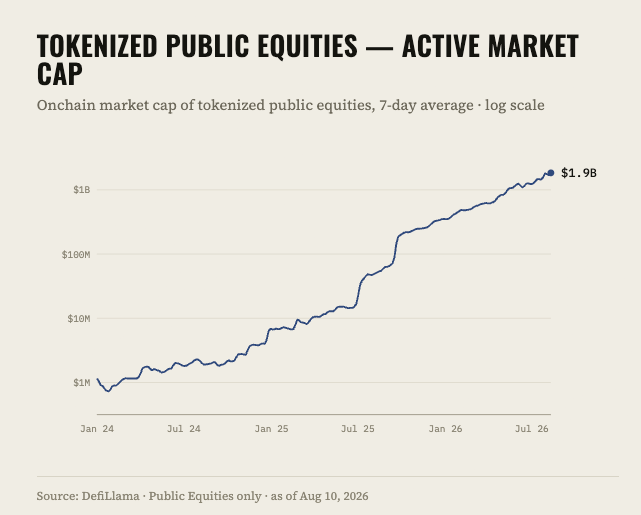
While this TVL growth is real and may well be the first step towards a tokenized universe, on its own, this rate of growth does not necessarily represent an evolution.
A tokenized asset, by itself, adds no value over a non tokenized one. In fact, it adds some of the challenges that tokenized assets carry with them: self-custody, lack of privacy, and the rest.
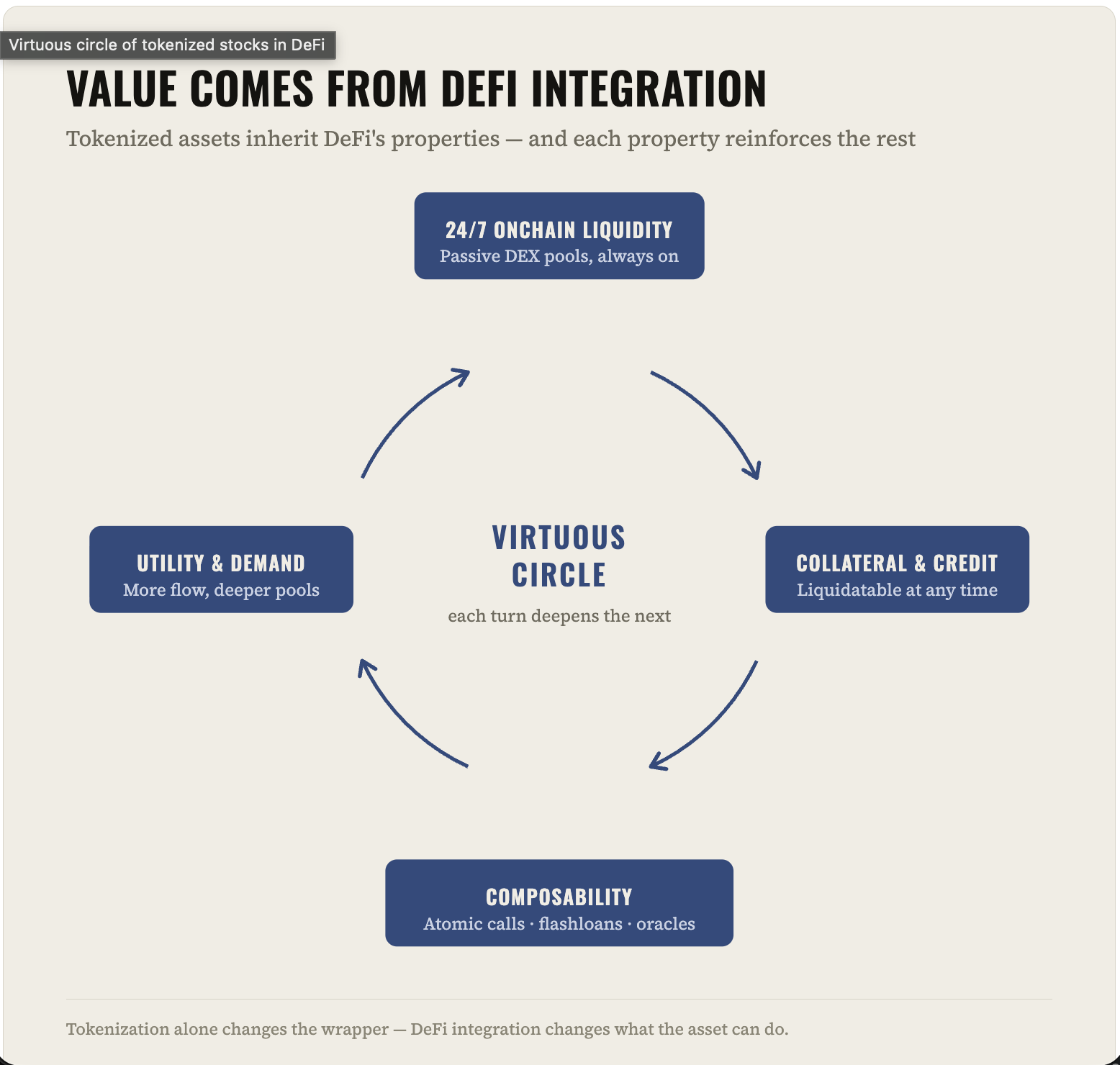
However, tokenized assets have the potential to add a lot of value once they are integrated into DeFi, because that is when they acquire its properties, and these properties build on each other, creating a virtuous circle:
- OneIntegration on pool DEXs will make 24/7 real. The tokens can be transferred after the market is closed, but without liquidity, this does not add any value by itself. You inherit the asset only adding custody and a crypto risk layer. A DEX pool has no opening hours, cannot reject you, and quotes the same way on Sunday at 3am as on Tuesday noon.
- Two24/7 liquidity is what will truly enable onchain collateral. A lending market works best with assets it can liquidate. Atomically, if the onchain pools have liquidity, you have guaranteed exit. No pool, no liquidator. No liquidator, no collateral.
- ThreeAnd collateral opens the door to much of what DeFi is made of: flashloans, leverage, onchain oracles, structured products, yield trading.
The circle closes on itself: integrations create organic demand for the liquidity that enables them. Depth attracts usage, usage justifies depth. Which means the real problem is a cold start problem. In this post we will look at where these integrations actually stand today, and what is blocking them.
Tokenized assets are not yet integrated onchain
So where do these integrations actually stand? We will look at the two layers that anchor the circle: DEX liquidity, the base everything else builds on, and lending pools, the first primitive built on top of it.
DEX liquidity
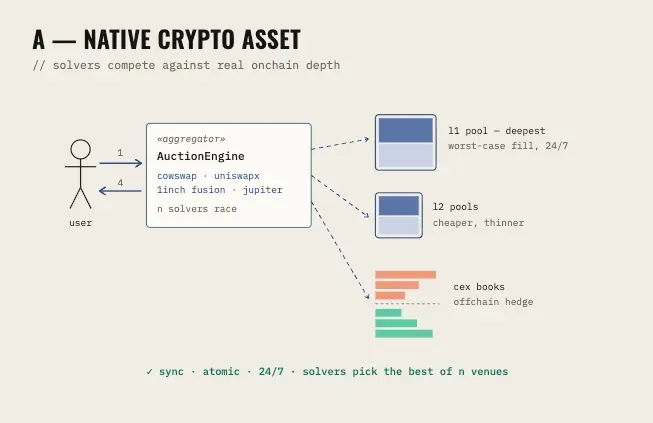
Trading a native crypto token onchain is an area where we have improved a lot over the years. If a token has onchain liquidity, you simply go to your preferred DEX or aggregator (CowSwap, Uniswap, Jupiter) and, with most tokens, you can be confident the order will fill at a reasonable price, no matter the time of day. Behind the scenes, every swap runs through an already very efficient competition between solvers, who race to route the order across pools, chains and offchain venues. The most liquid onchain pool always serves as the worst case availability scenario: even if nothing better exists at that moment, because a CEX API is down for instance, the trade clears against it, 24/7.
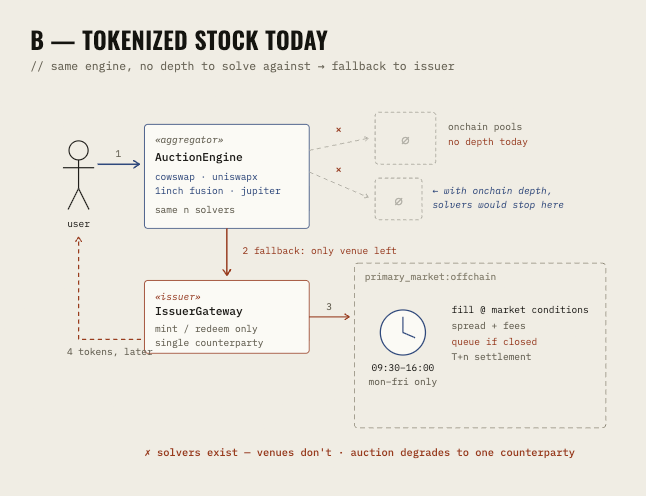
Tokenized stocks work nothing like this today. Most issuers rely on RFQ, with primary issuance as their main and often only source to fill user demand. There is mostly no solver ecosystem competing for the order, because there are no orderbooks or pools to fill it, and no passive pool guaranteeing a worst case fill.
Given the lack of integration, onchain users are expected to read through each issuer's docs, figure out where the asset can actually be traded, and understand the implications of that trade: some tokenized assets trade outside market hours, some do not. Some charge different fees during working hours, some do not. The routing infrastructure that makes native tokens feel effortless is, for tokenized stocks, still mostly nonexistent.
So let us try to measure this gap. Since solvers can only compete where there is depth to solve against, onchain market depth is a good proxy for how far tokenized stocks are from that experience. Let us check the current status by looking at the ±2% total depth of the most liquid tokenized onchain assets.
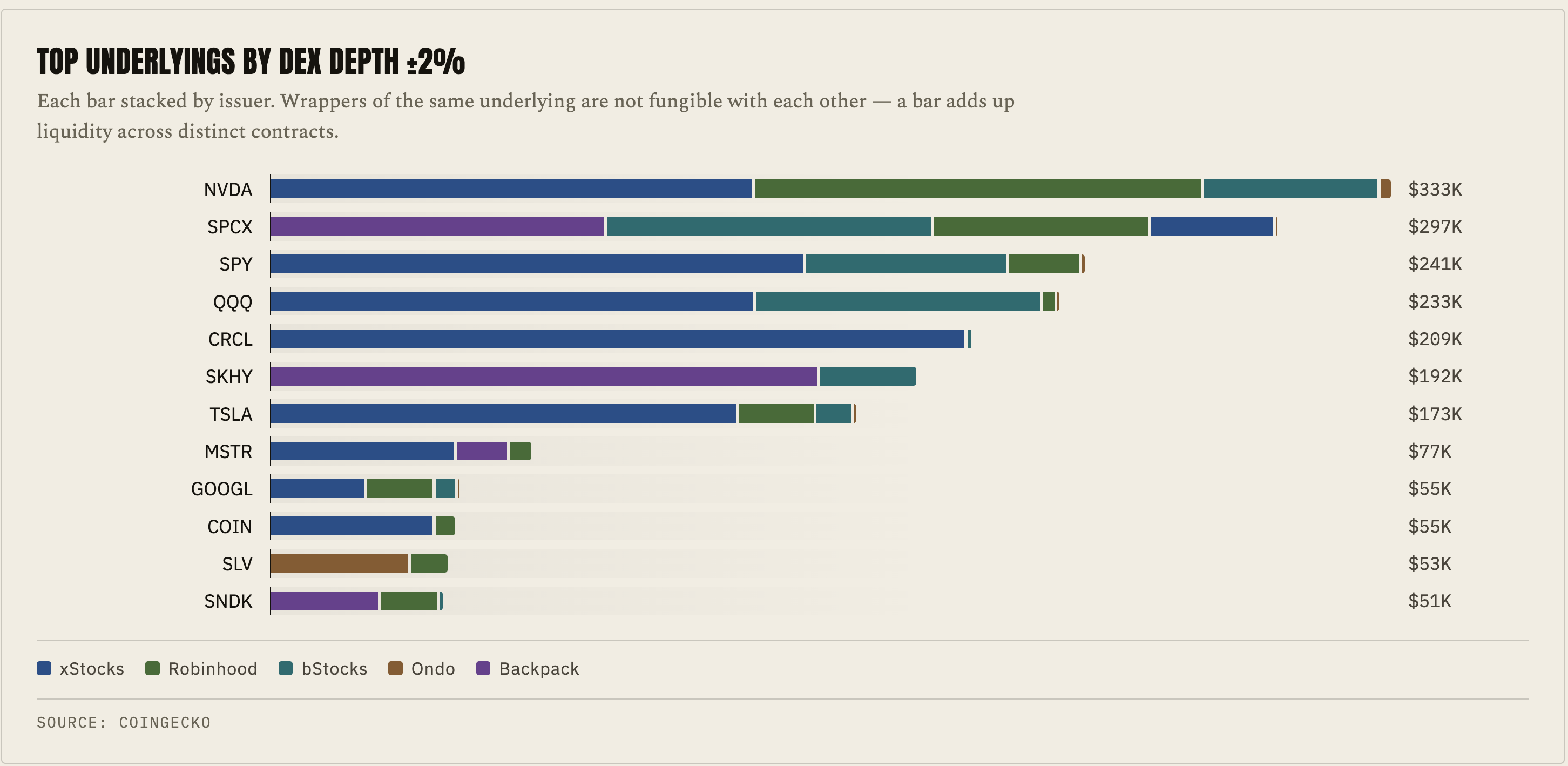
NVDA leads as the asset with roughly $333K of total depth split between xStocks, Robinhood and bStocks. For context, we can compare the market depth of the largest tokenized stock against the onchain depth at ±2% of some of the main tokens.
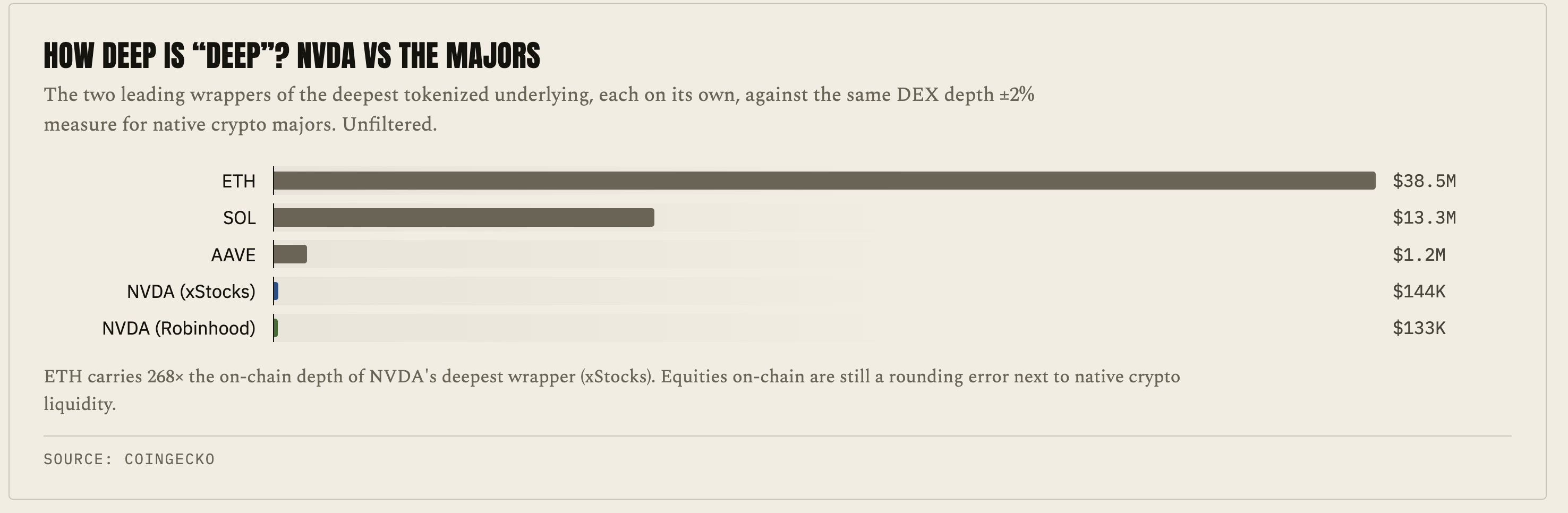
The most liquid tokenized stock lags the most liquid crypto assets by two orders of magnitude: ETH sits at $38.5M and NVDA at $144K.
Lending and borrowing
Lending is one of the core primitives in DeFi, and one of the few places where a tokenized stock can provide more value than the real stock. With onchain lending markets you can supply collateral and borrow stables in the same moment: no application, no counterparty, no waiting. With tokenized stocks we are still far from the same experience.
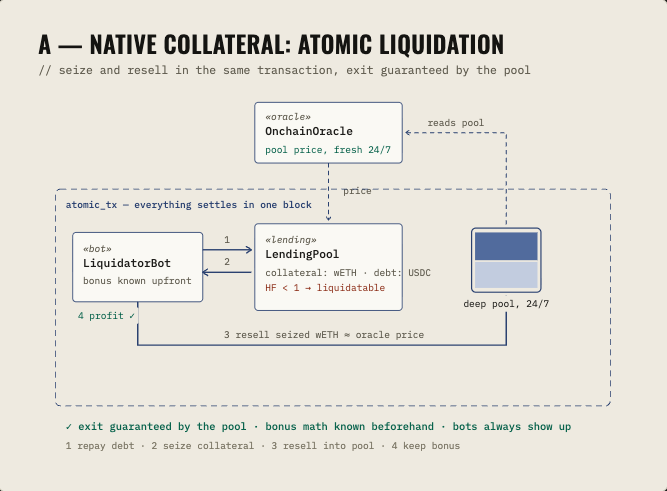
The lack of onchain liquidity is one of the key reasons. In DeFi, liquidation usually happens when a bot can atomically, in the same transaction, resell the seized collateral at a price close to what the oracle said it was worth. For native assets that exit always exists: there is a pool available at any hour, so the bonus math is known beforehand and bots show up.
In the case of tokenized stocks it is not that easy. A liquidator seizing a tokenized asset is unable to dump it into a pool, as there is no liquidity, so it has to hold the asset and carry the price risk until it can offload it. If the liquidation happens out of trading hours, the uncertainty is even bigger, as it will not have a primary source to sell into, and the value of the collateral will be unclear.
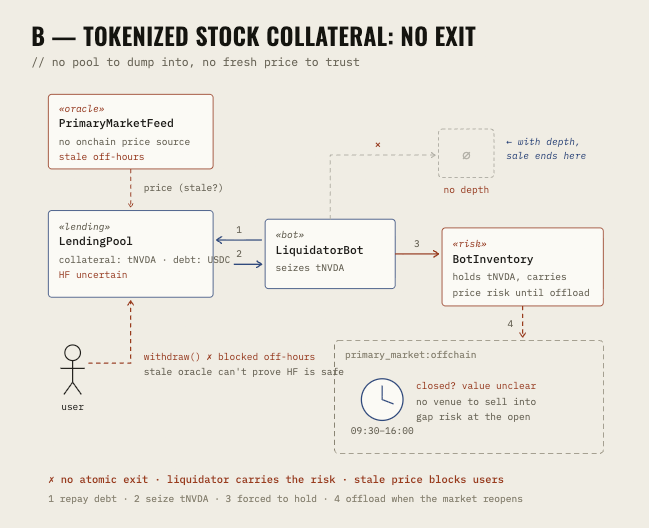
The lack of a secondary price creates a second problem. Lending pools in DeFi rely on oracles to determine the current health factor of a user. If there is no real onchain price for the collateral asset, they will need to rely on the primary source, which will be stale out of trading hours. This means that a user might not be allowed to reduce their health factor by withdrawing assets out of trading hours.
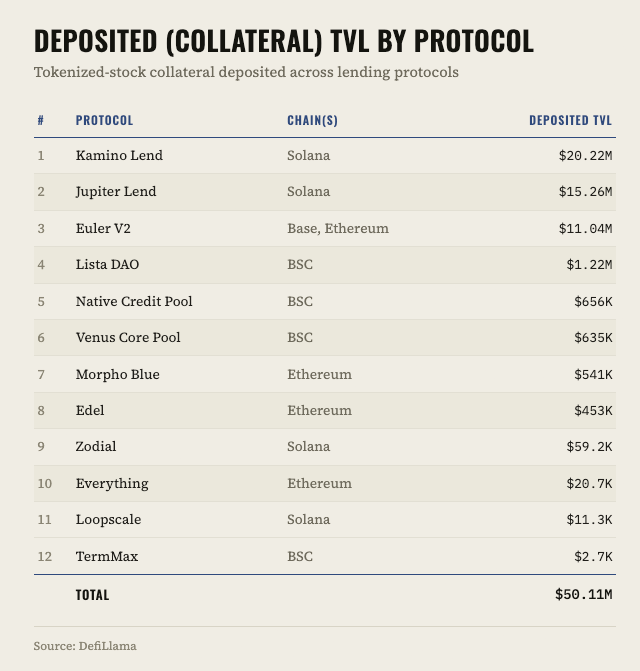
Protocols know these challenges, so they keep the vaults at experimental levels. LTVs launched at 35 to 50% and their size is relatively constrained. However we can find some incipient activity, mainly happening around xStocks, and predominantly on Solana, led by Kamino and Jupiter Lend. Euler v2 also shows up on Mainnet, largely thanks to a pool of xStocks' tokenized STRC (STRCx).
Where this leaves us
Everything above points to onchain liquidity as one of the key enablers here. Without trading pools, 24/7 trading, reliable liquidations and real collateral all become much harder to build.
Part of the problem is that this liquidity is unlikely to show up on its own. The main reason is that there is not much organic demand yet: users do not have many reasons to hold tokenized stocks, precisely because they are not integrated anywhere, so there is little volume and little fee income for LPs. LPs earn little, pools stay empty, and empty pools keep the assets from becoming useful. The virtuous circle, running in reverse.
Breaking that cold start probably requires someone to subsidize one side of it, and incentives are the obvious candidate if we follow the old DeFi farming playbook. There are some signs pointing in that direction: xStocks leads in onchain depth, and it is probably no coincidence that it is also the only issuer running a serious LP program (xPoints on Raydium, Orca and Byreal). More programs seem to be arriving too. On August 6, just a few days ago, Uniswap and Merkl launched rewards for Robinhood tokenized stocks on Uniswap v4.
DeFi integration is a slower and more complex problem than issuance. However, this integration is actually what can make tokenized stocks desirable. The value is there once they are integrated, since that is when they pick up the properties that make DeFi useful in the first place. The challenge right now is igniting the virtuous circle: some liquidity that enables some usage, some usage that justifies deeper liquidity.
I will re-run this analysis in a few months. The AUM chart tells you how much has been wrapped. If you want to know whether tokenized stocks are becoming DeFi assets, watch the depth.
Integration is what makes a token useful. The contract is what decides whose it is. This house measures both, and they are not the same reading: a version can sit in the deepest pool on the shelf and still be one clause away from a counter that can refuse you.
Depth is the measurement behind two of the six gates we publish, Circulation and Exit, and it is the reason a letter can move without the issuer touching anything. The other four are read in the documents.
$2.3B tokenized. $333K of depth.